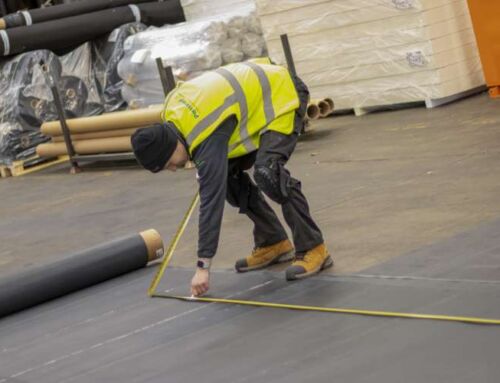
EPDM: The Manufacture of a Rubber Roof
As a part of our EPDM resources library, this paper takes a deeper look into the process of manufacture for an EPDM rubber flat roof. EPDM rubber flat roofing is growing in popularity across both commercial and domestic roofing sectors and has an industry-leading reputation.
EPDM is the stand-out candidate for flat roofing for the future. It combines durability and weather resistance with flexibility and cost efficiency. It is also one of the most environmentally friendly roofing products available.
A Brief History of EPDM
EPDM as a material was created in the late 1950s, to be used a construction material primarily in the Middle East. The construction industry required a material that would be resistant to the large fluctuations in temperature seen in the area.
The material needed to be able to withstand temperatures ranging from 120°C to -45°. EPDM was developed and proved to be an eminently suitable product.
The basic formulation of EPDM has remained fairly constant since its development in the 1950s, mostly thanks to the longevity seen in the product. Some EPDM rubber roofs installed as far back as the 1970s are still in existence and performing well.
Manufacturers of EPDM are not standing still though, with research, development and innovation ongoing. This is particularly relevant with the demands for products and manufacturers being environmentally aware.
Although the base product doesn’t look much different than in its infancy, installation methods and the design supporting these have advanced significantly.
This makes EPDM easy and safe to adhere, without lengthy or complex installation times or heavy resources requirement, often traditionally associated with flat roof application.
This benefit is also making a contribution to the popularity of EPDM rubber roofing systems in the DIY market.
The EPDM Manufacturing Process
Conventional natural rubber materials do not have the characteristics to make them suitable for roofing. They are inelastic, prone to expansion and have poor tensile strength and heat resistance. They are also not suited to being manipulated or adapted.
EPDM navigates these issues thanks to its synthetic composition. Its molecular structure can be selected and modified to suit multiple purposes, uses and requirements.
The process of manufacturing EPDM has very few stages and requires only a small amount of energy input. This is one of the ways that this product earns its environmentally friendly credentials.
Raw material choice
EPDM is classed as a polymer, being constructed from multiple molecules of low molecular mass combining to become one molecule of high molecular mass.
The components within EPDM are ethylene, propylene and ethylidenenorbornene.
When choosing the components of EPDM, the Mooney viscosity is considered. This is the widely recognised measure of the resistance to deformation over time through stress.

The ratio of ethylene to propylene is also a factor. This ratio has an impact on how and when degradation occurs, including the temperature at which this starts.
The ethylene content is one factor in this but also the microstructure of the compound. The higher the ethylene content of the EPDM, the higher the loading possibilities of the polymer. The other main element of EPDM is ethylidenenorbornene, which is the diene monomer in the product’s name. This is a single molecule, which contains two double bonds which work independently of each other.
Additives and fillers
In addition to the key ingredients, there are other products included within the formulation of EPDM which give added benefits to the polymer. Fillers such as calcium carbonate are used to provide resistance against weather conditions. They also improve the optical and mechanical properties and help to increase the elasticity level of the final product.
Additives are also used to protect against degradation. Degradation can occur through exposure to UV radiation, humidity and extremes of temperature, including very hot or very cold. The most common factor in degradation is UV radiation as this contributes towards destruction of the polymer. EPDM can also be affected by other substances which in effect ‘poison’ the product. The use of additives should minimise the impact of this. The additives need to be active within the composition to be effective. Formulation The final formulation of EPDM is comprised of the following:
- Ethylene-propylene polymers – the overall structure and determines the longevity.
- Mineral fillers – determining the strength of the final granule.
- Pigments – used for colouring.
- Plasticizers – used to harden the product and bond the granules.
- UV protection agent – providing weather resistance.
- Vulcanization agent – used within the manufacturing process.
Let’s look at vulcanisation in more detail.
Vulcanisation
Vulcanisation is the process by which a polymer, which has plastic properties, is turned into an elastomer, which is has rubber properties.
This happens when the chains of molecules become cross-linked, from being disordered in the polymer state.
If the process is completed correctly, the beneficial properties of the product become ‘fixed’.

This includes:
- Elasticity
- Resistance to tearing
- Hardness
- Resistance to abrasion and wear
- Energy return
- Resistance to breakage.
It is at this stage that the final shape of the product is determined whether this is a flat sheet to be used for roofing or a moulded shape such as a door seal.
Vulcanisation can also be referred to as ‘curing’ and takes place using either sulphur or peroxide. Both compounds link the polymer chains together and create either a Carbon-Carbon bond (C-C) or Carbon-Sulphur bond (C-S).
The use of sulphur
Using sulphur is the most used method of the two and has been used since the development of EPDM. It was used originally because it reacted will with all the polymer types in use at the time.
As the product has evolved, the same reaction can be achieved through the use of peroxide. The product choice is now dependant on type of polymer being formulated and the required outcome for the product. Sulphur has very low levels of toxicity whereas peroxide has a strong odour level and must be handled more carefully. Sulphur has high compatibility with other components and is very flexible. Peroxide can react negatively with other substances, so may be unsuitable for certain formulations.
Within the manufacturing process, the use of sulphur or peroxide can also be affected by cost considerations and the processing capability of the manufacturing plant. Vulcanisation using peroxide produces Carbon-Carbon bonds, which are more resistant to high temperatures, heat ageing and compression. Sulphur produces Carbon-Sulphur bonds which deliver a higher level of tensile and tear strength than the Carbon-Carbon bonds.
EPDM cured by peroxide demonstrates a better resistance to oils and chemicals, and there is no discolouration or staining found on PVC or metal products. It is also less likely to discolour. A sulphur-cured EPDM provides more choice on the use of fillers that can be used during the manufacturing process. In some cases, an additional post-curing stage is required after vulcanisation using peroxide. This is because of the reactions between peroxide and the other products in the process. For this reason, using sulphur for vulcanisation can be the most economical option for EPDM manufacturers.
Sheet Production
After the vulcanisation process has occurred, the EPDM granules are bonded into large sheets using heat. This creates large rolls of EPDM membranes which can be of a significant width and length. These sheets are then cooled.
At this stage, the sheets are fairly thin and imperfections within the material may have occurred. This is when two or more sheets are pressed together to create a more robust material. The sheets are pressed using heat and compression. The two sheets which are combined may be two new sheets, or one new sheet plus a recycled sheet. These sheets can be cut to the desired size for retailers, installers or commercial products.
Recycling
The recycling stage of the EPDM manufacturing process is another factor that contributes to the environmentally friendly status. Residual material from the production process, in addition to offcuts from construction and retail can both be recycled.
The product is simply reintroduced into the stages as described above and new sheets or moulded shapes are produced. Recycled EPDM becomes a cheaper option and is often used for industrial or commercial purposes, such as for flooring in children’s playgrounds.
EPDM waste can also be used as a fuel product, as it has a high calorific value.
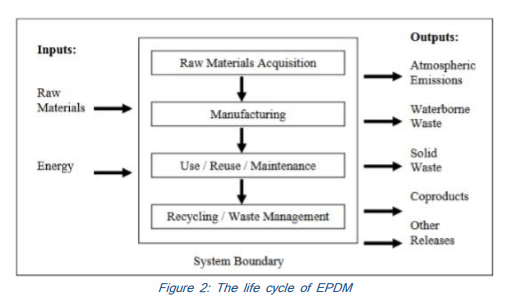
The EPDM Roofing Association commissioned a project in 2006 looking at the viability of recycling EPDM. This study was carried out by Firestone Building Products Company and Carlisle SynTec Incorporated and explored the options for the recycling process, what the estimated costs would be and the potential options for using the outputs.
The study was borne out of the realisation that a large amount of existing installed EPDM would be approaching its end of life stage. There was an estimated 20 billion-plus square feet of roofing in the USA installed over the previous 40 years.
The first stage of the project established that it was viable to remove the existing product from the roof and recycle this into a new membrane product. Within a year, EPDM totalling nearly one million feet had been removed and subsequently recycled.
This occurred through grinding the EPDM into a powdered substance, which was then used to create roofing walkway pads. The recycling programme spearheaded by the ERA has continued since 2007 too, with the ERA affiliate member Nationwide Foam collaborating in this.
Within North America, EPDM in excess of 13.5 million square feet of membrane has been removed and recycled. This has led to a reduction in the amount of waste that would have gone to landfill of 3.5 million pounds of EPDM.
Environmental Impact
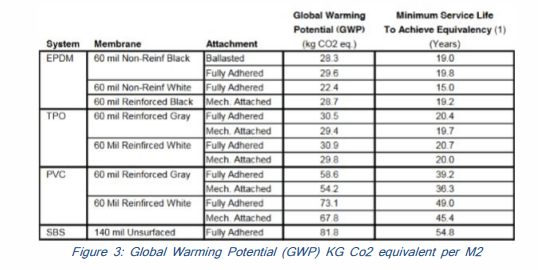
EPDM roofing is environmentally friendly throughout its product lifecycle, including its manufacture through to longevity and replacement rate.
In 2010, a Life Cycle Inventory and Assessment study (LCA) concluded that EPDM scored better in key categories than other bitumen-based and single-ply membranes.
These categories included:
- Acidification
- Global warming
- Smog generation.
The ATHENA® Institute have taken this data and used it within its processes for evaluating the environmental impact of buildings (both existing and new). The study looked at the whole process for production of EPDM, not just the final membrane product. It was one of the first studies of this type in the construction industry to do so.
How does EPDM compare to a silicone roof?
EPDM vs Silicone
Whilst EPDM has proven to be a popular synthetic rubber product for many purposes, comparisons to silicone rubber still exist.
The main difference between the two rubber products is in resistance to high temperatures. EPDM can reach a maximum temperature of 130°C (266°F), whereas some grades of silicone rubber can reach up to 270°C without degrading.
The impact of the high temperature is seen in the shrinkage level of the product. Silicone is also a sterile synthetic polymer, which makes it more appropriate to be used in certain circumstances such as in the beverage and food industries.
The use of silicone specifically for flooring and roofing purposes does not provide any additional benefits above the use of EPDM, especially in temperate climates.
In comparison to other more traditional roofing materials, EPDM can be maintained, restored and repaired easily. This enhances both its economic and environmentally friendly attributes. EPDM has strong resistance against UV over time and does not degrade or become brittle. The flexibility and tensile strength of the membrane are maintained.
Repairs and modifications can be made in a very straightforward manner. This involves washing the membrane and preparing the cleaned surface, with the repair materials and any additional coatings then being applied. EPDM roofing membranes can also be restored, enhancing their life expectancy.
A study in the USA reviewed the performance of roofing systems that had been installed between 28 to 32 years previously. The study found that all five systems
reviewed were performing as expected for their age. In fact, all the samples were in an ‘as new’ state, with properties at similar levels to membranes recently manufactured.
The study investigated the roofs both insitu and also in a laboratory. Momentum Technologies, a specialist testing facility, carried out tests on samples of the five
systems. The characteristics explored by the laboratory were those considered to be critical to performance:
- Elongation
- Tensile strength
- Thickness XD
- Thickness MD
- Factory seam strength
This study joins others carried out over several years which also support the premise that EPDM is an excellent long-term membrane product.
“The first field studies of EPDM were done in the late 1980s, and we are finding a pattern,” says Thomas W. Hutchinson AIA, FRCI, RRC and Principal, Hutchinson Design Group, Ltd., Barrington, Ill. “The pattern is that these roofs can really last a long time. By using today’s advanced design techniques and proper roof maintenance, it is reasonable to expect that an EPDM roof will approach or exceed 40 years of service.”
About Permaroof UK Ltd
Permaroof UK Ltd is the largest importer and stockist of EPDM rubber flat roof systems in the country and has a nationwide approved installer network through an industry-leading and Firestone-approved EPDM installation training program.