

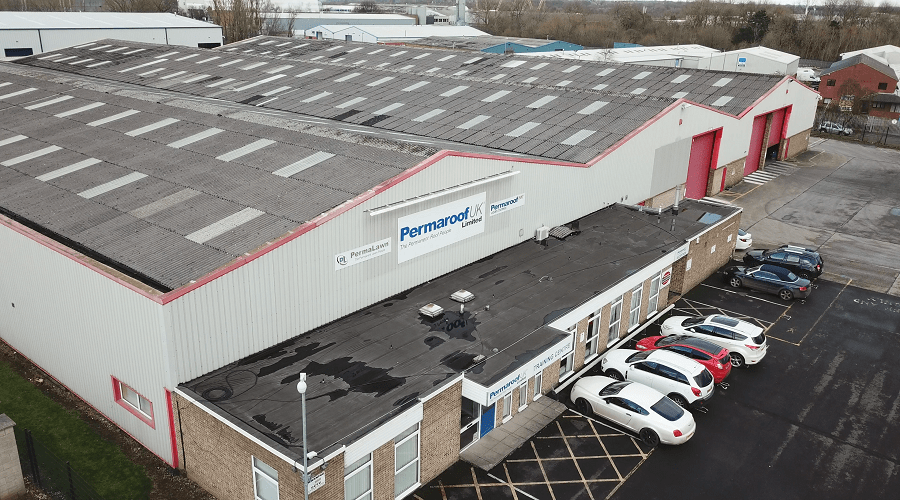
From electronic goods to clothing, the circular economy concept of reduce, re-use and recycle has been successfully applied across a multitude of industries – but to a lesser extent for construction and building components. Adrian Buttress, managing director at PermaRoof UK, discusses how EPDM rubber roofing can contribute to circular construction through modular building.
Circular economy is gaining more attention, particularly because it brings a potential solution to the tension between the growing demand and the limited supply of materials.
The climate change emergency is the biggest challenge facing our planet, and it is no secret that the construction industry consumes a significant number of global resources and generates a vast amount of rubbish.
n fact, the sector is the largest consumer of natural resources and the biggest contributor of waste. However, it can counteract this – and improve its reputation – by supporting the shift towards a circular economy through the use of more reusable and recyclable building stock.
When we usually talk about the circular economy, we think of consumer goods with a relatively short life. However, the principles can be applied to the construction industry, where the product is the building itself.
Modular construction – which involves creating property components in a factory environment and then transporting the modules to site to be assembled – perfectly fits the ideology of circular economy. It can also potentially be a key driver in carbon footprint reduction in the built environment industry and improve its sustainability credentials.
And this idea is becoming increasingly prevalent. Last year, the UK unveiled its Circular Economy Package, which committed to a 65% municipal recycling rate by 2035, and in tenders, sub-contractors are being asked to demonstrate their commitment to waste reduction.
Creating sustainable cities
Due to its resource and waste reduction, reusability, adaptability, and recyclability of all components, modular construction offers a multitude of environmental advantages. It is also demonstrated that prefabricated buildings are key to material savings, waste reduction, re-use of components, and various other forms of optimisation for the construction sector.
Modular builds are a new breed of structures that will be the cornerstone of modern, sustainable cities due to their ability to be modified, deconstructed, and relocated – re-using their parts almost like LEGO blocks.
Factory fabrication offers a very attractive option for projects where timescales are tight, or site and weather conditions are challenging. However, it is important the right materials are specified to offer improved building quality and long-term performance.
Choosing the right materials
In recent years, we have seen a surge in demand for modular construction – not just for residential properties, but also for public buildings such as schools and hospitals, as well as commercial properties like hotels and shopping centres.
One of the key strengths of modular builds is the speed of construction and arrival on site, which is where EPDM membranes truly shine as they can be fully adhered or mechanically fixed to the roof deck offsite.
Requiring no torch or hot works of any kind during installation, their cold-applied systems are very useful within the factory environment – as opposed to pitch roofs, which need to be installed once the modular is in place, requiring additional days and leaving the module temporarily open to the elements.
On any site, once the EPDM roofing membrane covers the deck, the roof is completely watertight. As much detailing as possible is also carried out in factory conditions. This minimises the substrate’s exposure to dust, pollution, and moisture – significantly reducing the risks associated with external conditions.
EDPM membranes are strong and flexible, with excellent puncture resistance, ensuring a resilient solution within a busy factory environment. Water-based adhesives have also been developed to ensure the factory installation process is safe and virtually odourless, addressing the management of volatile organic compounds (VOCs) and solvents in a factory environment.
More importantly, EPDM membranes are completely aligned with modular building concepts, allowing not only design flexibility but also the possibility to adapt to future changes, dismantle, re-use or relocate the building – even decades after its initial construction.
If the building must be modified or relocated after a long time, detailing, and sealing the bay-to-bay joins can be easily done, giving life once again to an old material but performing like a new membrane. The customer has the freedom to relocate and adapt the building modules after construction – truly contributing to circular economy.
Another consideration when creating modular buildings is creating the structure using steel. Steel-framed buildings are fast, cost-efficient methods of construction and have taken the market by storm in recent years.
The buildings are manufactured to last utilising galvanised steel, which is one of the strongest materials used in the industry – with the added bonus of not burning in a fire or rotting and allowing moisture to sink through.
As well as their strength, durability and how quickly they can be constructed, some steel-framed buildings on the market are made from 60% recycled materials and fully recyclable when they come to the end of their life, again, fitting with the ideology of the circular economy.
Conclusion
While modular construction may not always be the right choice for every project, it is increasingly being considered as a potentially advantageous alternative to conventional building methodologies, meeting market demands as well as the challenges posed by sustainable building practices.
And as the largest contributor of waste, construction is a key industry in moving towards a more sustainable model of re-use, recycling and zero waste.
This is why it is so important that building product manufacturers work together with the modular sector to ensure the buildability and performance profiles of their products meet the requirements of modular buildings, bringing more flexibility to this growing trend and supporting circular construction practices.
For more information on PermaRoof UK, please call 01773 608839.
Share This Story
Get in Touch
Please leave your details and someone from the PermaRoof UK team will be touch shortly to help you with your enquiry.
Permaroof UK® Ltd
Unit 1
Westway
Cotes Park Industrial Estate
Alfreton
Derbyshire DE55 4QJ
Tel: 01773 608 839
Fax: 01773 608 408
Email: Click here
Registration No. 4109502
VAT No. 764 2785 00
Permaroof (UK) LTD
Opening Hours
Mon – Fri (8am / 5pm)
We are closed on bank holidays and we re-open the following working day at 8am. Feel free to send us your enquiry during these periods and we can get back to you.
CONTACT PERMAROOF UK
PermaRoof UK are on hand to answer any questions regarding our products, services or your order. We welcome enquiries from the trade, stockists and homeowners alike. Contact PermaRoof UK today using the below form and one of our experienced team members will be on hand to help you right away.
Permaroof UK® Ltd
Unit 1
Westway
Cotes Park Industrial Estate
Alfreton
Derbyshire DE55 4QJ
Tel: 01773 608 839
Fax: 01773 608 408
Email: Click here
Registration No. 4109502
VAT No. 764 2785 00
Permaroof (UK) LTD
PermaGroup Brands, Partners and Clients
PermaGroup has established links with some of the biggest names in our industry thanks to our reputation of excellence. Read more about becoming a supplier or stockist here.


